
For any establishment planning to market a medical device in Malaysia, one of the very first and most critical steps is understanding how classification works. Many organizations underestimate this stage, assuming it is just a technical formality. In reality, medical device classification is the foundation of the entire regulatory pathway set by the Medical Device Authority (MDA).
Why does this matter? Because classification directly determines how complex the registration process will be, how much documentation is required, how long approval takes, and even the overall cost. A wrong classification doesn’t just slow you down — it can mean rejection, regulatory delays, or costly rework.
What Is Medical Device Classification
Medical device risk classification is the system used to categorize devices into classes based on their potential risk to patients and users. In Malaysia, devices are classified into Class A, B, C, and D, aligned with the ASEAN Medical Device Directive (AMDD). Each class dictates the regulatory pathway, documentation requirements, and the level of scrutiny applied by the MDA.
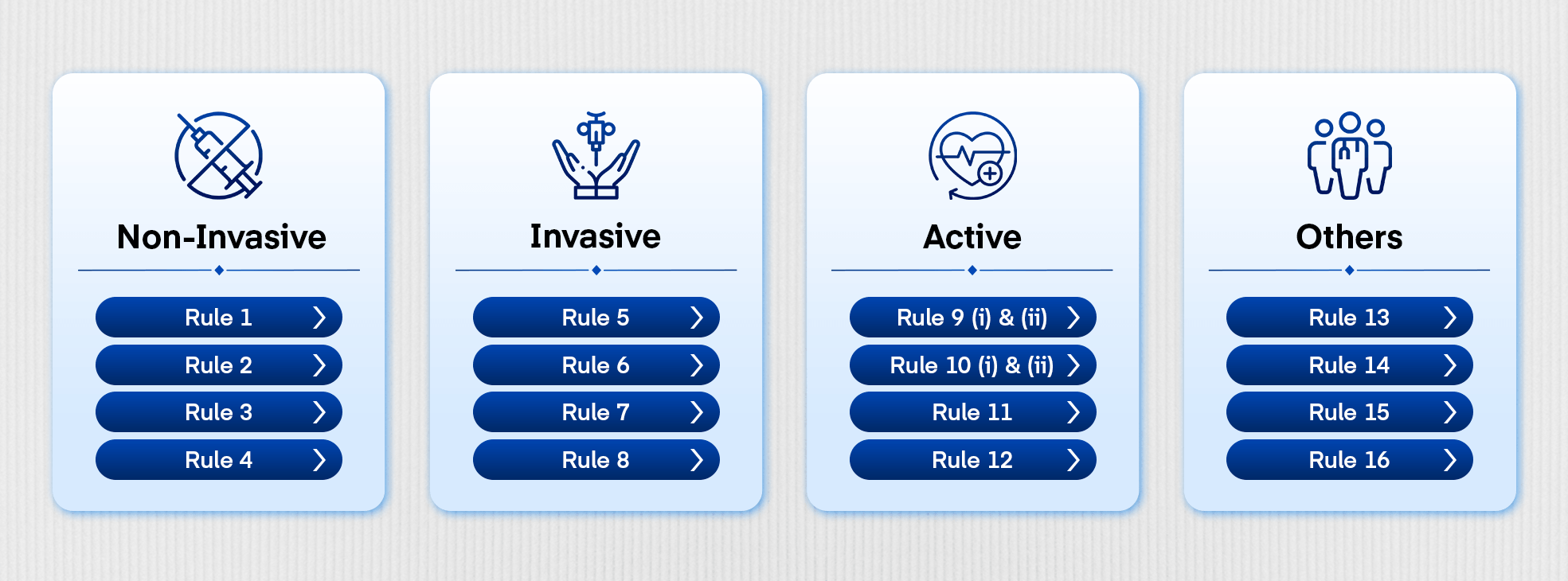
Malaysia Medical Device Classification Rules
Medical device classification in Malaysia is governed by the Medical Device Regulations 2012, enacted under the Medical Device Act 2012 (Act 737). These regulations set out the framework for categorizing devices according to risk, ensuring that each class follows the appropriate regulatory pathway, documentation requirements, and level of oversight by the MDA.
Malaysia medical device classification rules:
Key Factors That Determine Medical Device Classification
An establishment intending to register a medical device shall obtain and fully comprehend the following information to ensure accurate classification of its products. Such information is typically documented in the product brochure, instructions for use or user manual, and labeling. Consultation with the manufacturer may also be undertaken when necessary.
|
List
|
Key Factors
|
Examples
|
||
|---|---|---|---|---|
|
1
|
The duration of contact of the device with the body
|
· Transient use - Surgical scalpel
· Long term use - Orthopaedic implants |
||
|
2
|
The degree of, and site of, invasiveness into the body
|
· Non-invasive - Plaster
· Invasive - Catheter |
||
|
3
|
Whether the device deliver medicines or energy to the patient
|
· Deliver medicine - Infusion pump
· Deliver or exchange energy - Defibrillator |
||
|
4
|
Whether the device is intended to have a biological effect on the body
|
· Drug eluting-stent
|
||
|
5
|
Intended action on the human body
|
· Therapeutic - Dialysis machine
· Diagnostic - Blood pressure monitor · Supportive - Cardiopulmonary bypass machine |
||
|
6
|
Local versus systemic effects
|
· Local - Skin dressing
· Systemic - Mechanical ventilator |
||
|
7
|
Whether the device comes into contact with injured skin
|
· Burn dressing
|
||
|
8
|
Whether for diagnosis or treatment
|
· Diagnosis - Stethoscope
· Treatment - Pacemaker |
||
|
9
|
The ability to be re-used or not
|
· Single use - Hypodermic needle
· Reusable - Infrared thermometer |
||
|
10
|
Combination of devices
|
· Bone graft with antiseptic
|
||
Once sufficient information has been gathered and properly understood, the establishment shall review the criteria set forth under the relevant classification rules in the Medical Device Regulation 2012 to determine the most appropriate medical device classification. Alternatively, the establishment may consult the MDA Public Search to review the classifications of registered medical devices.
Why Proper Classification Is Important?
An incorrect classification can derail your entire medical device registration process. It may cause rejection, regulatory delays, or significant additional costs.
That’s why it pays to work with experts. Contact Global Rep and consult with our professionals. With years of proven experience, we can guide you in determining the correct classification and help you successfully navigate this critical step.
For a deeper dive into what comes next after classification, refer to our blog: Malaysia Medical Device Regulatory Affairs: Overview of Regulatory Framework and Requirements — where we outline the subsequent steps in the registration pathway and compliance process.
You may also refer to our blog: Navigating Malaysia’s Medical Device Registration Process, which highlights the key elements of Malaysia’s medical device registration framework, helping establishments prepare for documentation, timelines, regulatory expectations, and the necessary monetary investment.