Recognition of foreign pre-market approvals is a clear and growing global trend in medical-device regulation. The terminology varies—regulatory reliance, abridged review, verification, recognition of overseas assessments, etc.—but the underlying principle is the same:
Regulators increasingly leverage the work already performed by trusted foreign regulators instead of repeating the entire assessment from scratch.
Historically, a manufacturer entering each country generally had to undergo a separate national regulatory assessment:
Foreign approval → New national assessment → New national approval
The emerging model is:
Trusted foreign approval → Reliance / verification / abridged review → Faster national market access
This is being driven by the need to reduce regulatory duplication, shorten time-to-market, conserve regulatory resources and improve patient access. However, this concept has yet to be fully accepted by many authorities.
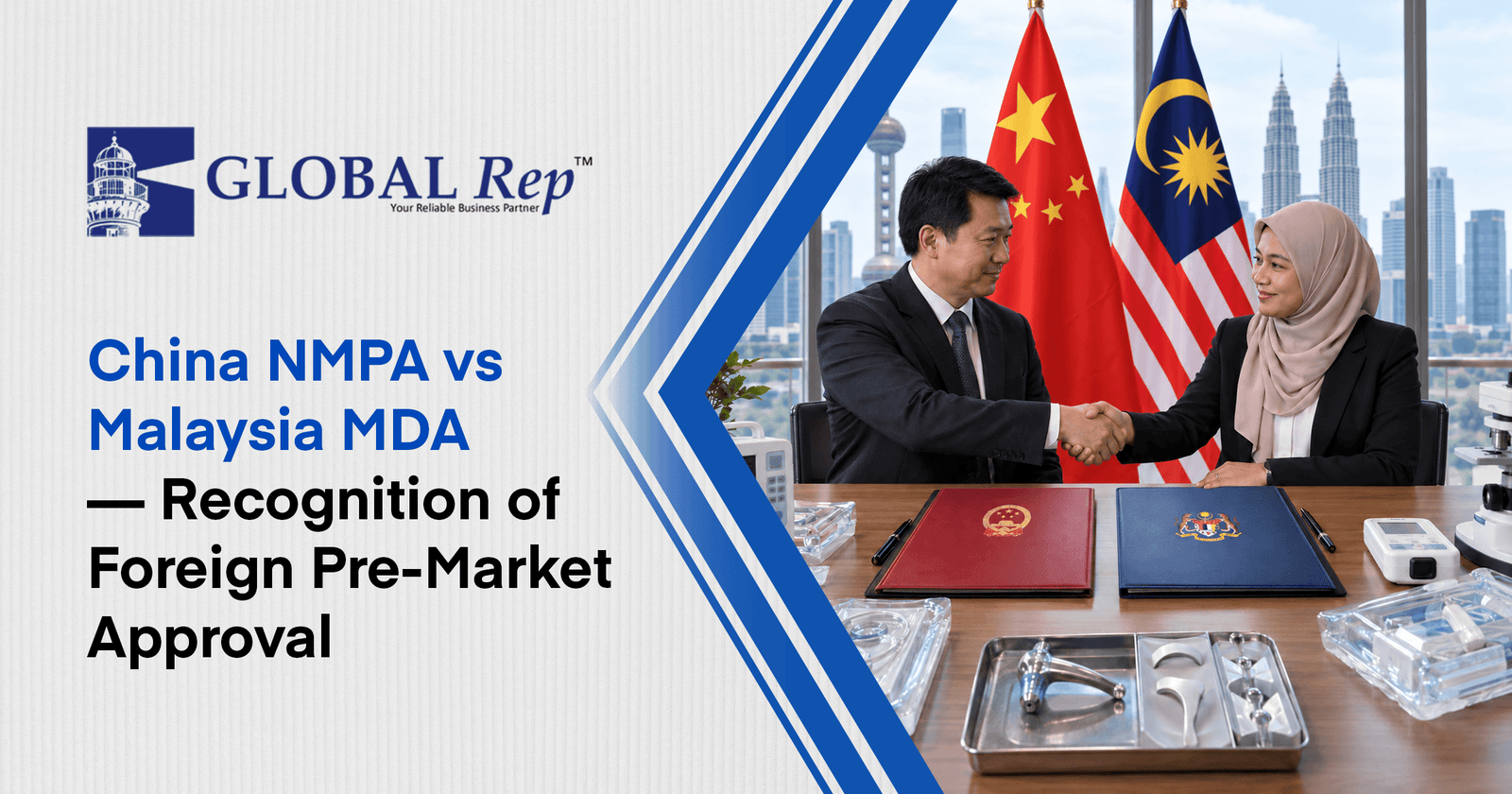
The following comparison highlights a key difference between China NMPA and Malaysia MDA in their treatment of foreign pre-market approvals.
| Aspect | China NMPA | Malaysia MDA |
|---|---|---|
| Accepts foreign pre-market approval? | Yes, as supporting evidence | Yes, for recognised foreign authorities under the verification pathway |
| Does foreign approval replace local approval? | No | No |
| Can foreign approval reduce local assessment? | No | Yes |
| Formal verification/reliance pathway? | No | Yes |
| Foreign authorities recognised? | Foreign competent-authority marketing certificate is required for imported devices, as supporting evidence | Yes. MDA maintains a defined list of recognised competent authorities |
| Use of foreign technical/clinical evidence | Yes, subject to NMPA requirements | Yes, through verification of evidence |
| Local conformity assessment repeated? | Generally, NMPA performs its own regulatory review | Full assessment can be avoided/reduced if eligible for verification |
| Local product registration still required? | Yes | Yes |
While NMPA accepts foreign regulatory approvals as supporting evidence for imported medical devices, manufacturers must generally undergo NMPA’s own regulatory review and foreign approval does not reduce the local assessment in a broad reliance pathway. In contrast, MDA has established a formal verification pathway that allows eligible medical devices with approvals from recognised foreign regulatory authorities to leverage existing conformity-assessment evidence, potentially reducing duplication of assessment, regulatory time and cost. The eligibility criteria for accessing Malaysia’s Conformity Assessment by Way of Verification Route are set out in the Medical Device Authority (MDA) Guidance Document.
In both markets, foreign approval does not replace local market authorisation; NMPA or MDA approval remains necessary before the device can be placed on the respective market.
Medical device pre-market approval can be a lengthy and costly process. By recognising eligible foreign pre-market approvals, Malaysia MDA has significantly accelerated market entry and reduced regulatory costs, making Malaysia a more attractive gateway for medical device manufacturers seeking access to the Malaysian and regional market.
The following table provides a comparison of the typical market-entry turnaround time and estimated regulatory costs for medical device registration under China NMPA and Malaysia MDA.
| China NMPA | Malaysia MDA | ||
|---|---|---|---|
| TAT | CAB conformity assessment | Not applicable | Class B–D: 30 - 60 working days after complete submission |
| Regulatory evaluation |
Class I: 5 working days Class II: 60 working days Class III: 90 working days |
Class A–D: 30 - 60 working days after complete submission |
|
| Typical overall time |
Class II: ~12–24+ months Class III: ~18–36+ months |
Class B, C & D: ~3–5+ months | |
| Cost | Regulatory evaluation |
Class I: Not required Class II: RMB 210,900 ≈ US$29,500 Class III: RMB 308,800 ≈ US$43,200 |
Class A: RM1,250 ≈ US$315 Class B: RM1,250 ≈ US$315 Class C: RM2,500 ≈ US$625 Class D: RM3,750 ≈ US$940 |
| CAB full conformity assessment (FCA) | Not applicable |
Class B: ~ US$3,750 Class C: ~ US$6,250 Class D: ~ US$8,750 |
|
| CAB conformity assessment via verification route (VR) | Not applicable | Class B, C & D: ~ US$300 | |
| Estimated total market-entry cost (excluding profession regulatory affairs supports fee) | Class II: ~US$30,000 Class III: ~US$50,000 |
Class A: ~ US$315 Class B: ~ US$4,500 (FCA)/650 (VR) Class C: ~ US$6,500 (FCA)/ 950 (VR) Class D: ~ US$10,000 (FCA)/1,250 (VR) |
|
| Relative cost | Higher | Lower | |
| Relative speed | Slower | Faster |
In our blog, “Which Southeast Asian Country Should You Enter First?”, Malaysia is identified as a “practical regional entry point” for foreign medical device manufacturers looking to test the market, gain ASEAN experience, and establish a foundation for regional expansion.
Find the Right Regulatory Pathway into Malaysia
If your medical devices have already obtained pre-market clearance from an MDA-recognised reference authority, we invite you to contact Global Rep to assess your regulatory readiness and identify the most efficient pathway to enter the Malaysian and wider regional markets.
With an established market portfolio and extensive experience supporting Chinese medical device manufacturers, Global Rep understands the regulatory and commercial challenges of expanding into Malaysia and ASEAN. Our practical market experience, together with positive testimonials from Chinese manufacturers we have supported, demonstrates our commitment to delivering reliable, responsive and cost-effective regulatory solutions.