Understanding Medical Device Regulatory Affairs
Medical device regulatory affairs is the discipline that ensures medical devices are developed, approved, and marketed in compliance with national and international regulations. It serves as the critical link between manufacturers, quality systems, and regulatory authorities to safeguard patient safety, enable legal market access, and maintain ongoing compliance.
In practice, medical device regulatory affairs encompasses all activities required to keep devices safe, effective, and legally compliant throughout their lifecycle — from design and development through regulatory approval to post-market surveillance. It is the bridge that connects innovation with regulatory oversight, ensuring that medical devices reach patients responsibly and remain compliant once in use.
Regulatory Authority and Legal Framework in Malaysia
In Malaysia, medical devices are regulated by the Medical Device Authority (MDA), a statutory body under the Ministry of Health (MOH). The MDA safeguards public health by ensuring compliance across the entire lifecycle of medical devices — from pre-market evaluation and market authorization to post-market surveillance.
The core legal framework includes:
- Medical Device Act 2012 (Act 737) — highest-level governance framework for medical devices. It establishes the legal foundation for how medical devices are regulated, marketed, and monitored in the country.
- Medical Device Regulations 2012 — subsidiary laws under Malaysia’s Medical Device Act 2012 (Act 737). It provides the detailed rules and procedures for how medical devices must be registered, licensed, and monitored.
- MDA circular letters — official policy documents to clarify, update, or announce regulatory requirements.
- MDA Guidance documents — practical documents that explain how to comply with the law.
Medical Device Classification in Malaysia
In Malaysia, a “medical device” is defined under the Medical Device Act 2012 (Act 737) as any instrument, apparatus, implement, machine, appliance, implant, reagent, software, material, or other similar article intended by the manufacturer to be used, alone or in combination, for human beings to diagnose, prevent, monitor, treat, or alleviate disease, injury, or disability.
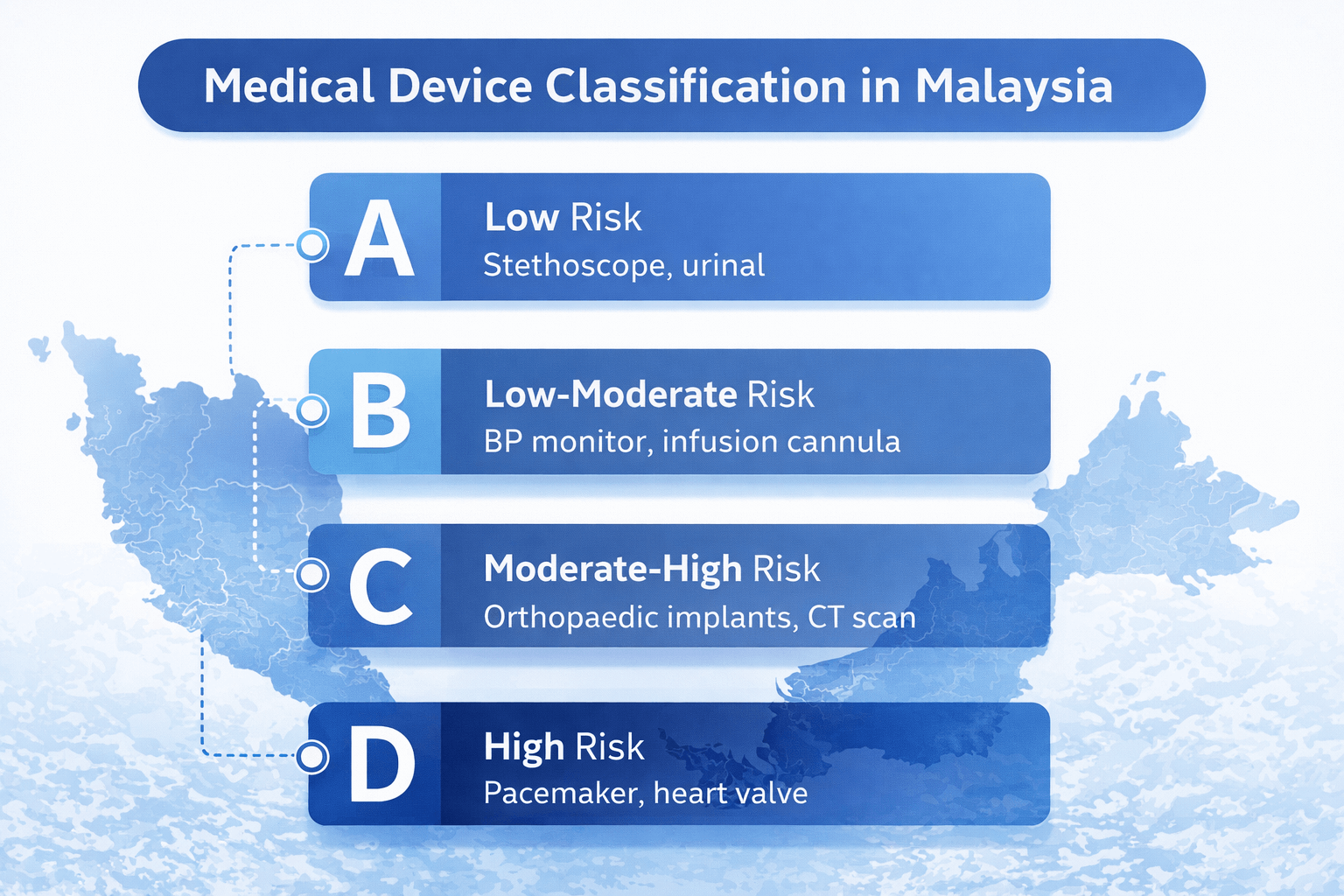
Medical device classification is the cornerstone of the pre-market approval process, as it defines the risk category of a device and determines the conformity assessment pathway required for product registration.
This classification aligns with ASEAN harmonization principles — the same categories used across the region. The higher the class, the more scrutiny and documentation are required during registration.
The Medical Device Registration in Malaysia Step by Step
Step 1: Medical device?
Assess whether the product meets the definition of a medical device under Malaysia’s Medical Device Act 2012.
Step 2: Risk classification
Determine the device’s risk classification (Class A, B, C, or D) according to the risk classification criteria.
Step 3: Prepare submission dossier
Establish comprehensive technical documents conforming with the Medical Device Regulation 2012 and associated requirements.
Step 4: Conformity assessment by CAB
Appoint an MDA registered CAB to assess the dossier of Class B, C & D devices.
Step 5: MDA evaluation
Submit CAB’s device conformity assessment certificate and report, and dossier to the MDA’s online platform – MeDC@St, for MDA evaluation.
Step 6: Device registration approval
Upon successful evaluation, the MDA issues registration approval. The device is then legally permitted to be marketed and distributed in Malaysia.
Common Challenges and Mistakes
1. Misclassification of Devices
Assuming a device falls under the same risk class as in another jurisdiction—without referencing Malaysian classification rules—can result in inappropriate regulatory pathways and significant delays in registration.
2. Incorrect Grouping of Devices
Device grouping that does not meet the criteria outlined in the MDA guidance document often leads to rejection or requests for resubmission.
3. Documentation Discrepancies
Frequent causes of queries by the CAB and MDA include typos in critical information (device name, product identifier), missing required documents, insufficient pre-clinical studies, incorrect, contradictory, or incomplete labeling content, documents lacking company name or approval details.
4. Late CAB Engagement
Delaying the appointment of a Conformity Assessment Body (CAB) can stall the entire submission cycle. Early engagement is essential to align expectations, timelines, and requirements.
5. MeDC@St Submission Errors
Common issues flagged by evaluators include typos in device name, product identifier, manufacturer name, or address, incomplete uploading of required documents These errors often cause applications to be returned for rectification, prolonging approval timelines.
6. Failure to Address Assessor Queries and Poor Communication
Post-Market Surveillance and Compliance
Device approval is not the end of your regulatory responsibilities. Manufacturers must maintain compliance through:
- Actively collect device safety and performance information
- Submit information demanded by MDA
- Submit device change notification
- Retaining complete distribution records
- Vigilance and reporting of adverse incidents
- Renewing device registration every five years
- Responding to MDA requests for information
Active post-market surveillance protects patients and ensures your product remains compliant as regulations evolve.
Compliance as a Cornerstone of Market Success
Understanding and executing the medical device approval process in Malaysia is essential for manufacturers who want successful market entry and sustained commercial presence. Through careful planning, accurate classification, solid documentation, and ongoing regulatory diligence, you can build a compliance pathway that protects patients and supports business goals.
Simplify Your Medical Device Regulatory Approval in Malaysia
Navigating Malaysia’s medical device regulatory requirements can be complex, from device classification and documentation to CAB assessment and MDA registration. Our team can support you throughout the entire regulatory process to ensure smooth compliance and faster market entry. Contact us today to get expert guidance and streamline your approval journey with confidence.