
Nowadays, turning to AI platforms for answers has become a common practice. These systems generate responses by breaking user input into tokens, processing them through a neural network known as a transformer, and predicting the most probable next word step by step until a complete answer is formed. Unlike databases, they do not “know” facts directly but rely on statistical patterns learned from extensive training data.
The accuracy of AI responses depends largely on the quality of the training data, the robustness of ongoing model maintenance, and how closely real-world context aligns with the conditions under which the model was trained. Inaccuracies often arise from poor data quality, model drift, or hallucinations—where the system produces information that sounds plausible but is not factually correct.
On August 29, 2026, the following question was posted simultaneously to Microsoft Copilot, Google Gemini, and ChatGPT:
“Why is an establishment not permitted to register a medical device through the verification pathway by leveraging the full conformity assessment already completed by another establishment?”
The responses provided by these platforms are displayed below.
Microsoft Copilot response:
An establishment is not permitted to use the verification pathway for a medical device that has already been registered via full conformity assessment in Malaysia because the verification route is designed exclusively for devices with recognized international premarket clearance.
Google Gemini response:
1. Distinct Regulatory Purpose & Sequence
- Verification Route: Designed solely as an expedited, reliant assessment pathway for devices that hold valid prior approvals from MDA-recognised foreign reference authorities (e.g., US FDA, EU CE, Singapore HSA, TGA Australia). The Conformity Assessment Body (CAB) relies on the foreign review to verify local compliance rather than doing a full evaluation.
- Full Conformity Assessment (FCA): Designed for devices without qualified foreign reference approvals or those undergoing complete local evaluation in Malaysia.
Once a device goes through FCA, its regulatory baseline for Malaysia is already established via full domestic evaluation. Re-entering through a verification pathway intended for foreign market reliance contradicts the hierarchy of the regulatory routes.
2. Duplication & Invalid Reliance Logic
The verification route exists to avoid double-evaluating clinical and technical data that another trusted foreign agency has already vetted.
- If a medical device has already undergone Full Conformity Assessment locally, Malaysia’s CAB and MDA have already performed the highest-tier, full-dossier evaluation.
- Attempting to use the verification route on an already FCA-assessed device would mean asking a CAB to “verify” the device using foreign evidence for a product that has already proven its compliance via Malaysia’s own complete assessment route.
3. Maintenance and Lifecycle Pathways (Re-registration)
When a device registered via Full Conformity Assessment needs to be renewed, maintained, or updated:
- Renewals/Re-registration: The establishment must maintain the existing conformity assessment certificate (FCA) or use MDA’s official Re-registration Route (such as the automated re-registration in MeDC@St) rather than applying for a brand-new registration under a different evaluation route.
- Design/Device Changes: Modifications are handled through Change Notifications (CN) under the original FCA registration baseline, not by re-filing through the Verification Route.
ChatGPT response:
The key point is that the verification pathway is not simply an alternative registration route that an establishment may choose whenever a device is already registered in Malaysia. It is an abridged conformity-assessment pathway based on reliance on an approval from a recognised foreign regulatory authority or notified body.
Under the current MDA/GD/0070 guidance, for initial registration by verification, the device must, among other things:
- have approval from at least one recognised regulatory authority or notified body;
- have the same design and intended purpose as the device approved by that authority/body; and
- satisfy the specified global safety requirements.
Why a device already registered by full conformity assessment is different:
If the device has already gone through full conformity assessment in Malaysia, its Malaysian registration is based on the Malaysian CAB’s own assessment of the manufacturer’s conformity evidence. The verification route is intended to leverage an existing recognised foreign assessment, rather than to provide a second, abbreviated route for an already-established Malaysian registration.
In other words, the regulatory logic is: Foreign recognised approval → verification/abridged assessment → Malaysian registration; Rather than: Existing Malaysian full-assessment registration → switch retrospectively to verification.
The MDA guidance does, however, expressly recognise verification for re-certification/re-registration of a device that was previously registered in Malaysia. It states that, for recertification, the device may have been assessed through either full conformity assessment or verification, provided that it has a valid registration certificate and meets the other eligibility conditions.
So there is an important distinction:
|
Situation
|
Verification pathway
|
|
|---|---|---|
|
Device is being registered for the first time and has an eligible foreign approval
|
Potentially yes
|
|
|
Device already registered in Malaysia following full conformity assessment, and you want to create another initial registration using verification
|
Generally no
|
|
|
Device is already registered in Malaysia and is undergoing eligible re-registration/recertification
|
Potentially yes, subject to the verification criteria
|
|
The underlying regulatory reason:
Allowing an establishment to take an existing Malaysian registration that was obtained through full conformity assessment and simply re-register it through verification could effectively bypass the assessment pathway that was used to establish the device’s Malaysian conformity. Verification is based on regulatory reliance on an eligible external assessment; it is not designed as a mechanism for changing the conformity-assessment basis of an existing registration.
This is also consistent with MDA’s current framework, where conformity assessment is a prerequisite to registration under Section 7 of the Medical Device Act 2012, and the level/type of assessment depends on the applicable pathway and risk.
Confused? Let us clarify
Our technical team has conducted a comprehensive review and analysis of the AIgenerated responses. We have determined that this particular question has not yet been sufficiently addressed or discussed within available online sources. Consequently, the AI platforms appear inadequately trained to provide a complete and reliable answer at this stage.
Rather than leaving the matter unresolved, we invite you to join us as we dissect and examine the question together—step by step—towards a clearer understanding.
“Why is an establishment not permitted to register a medical device through the verification pathway by leveraging the full conformity assessment already completed by another establishment?”
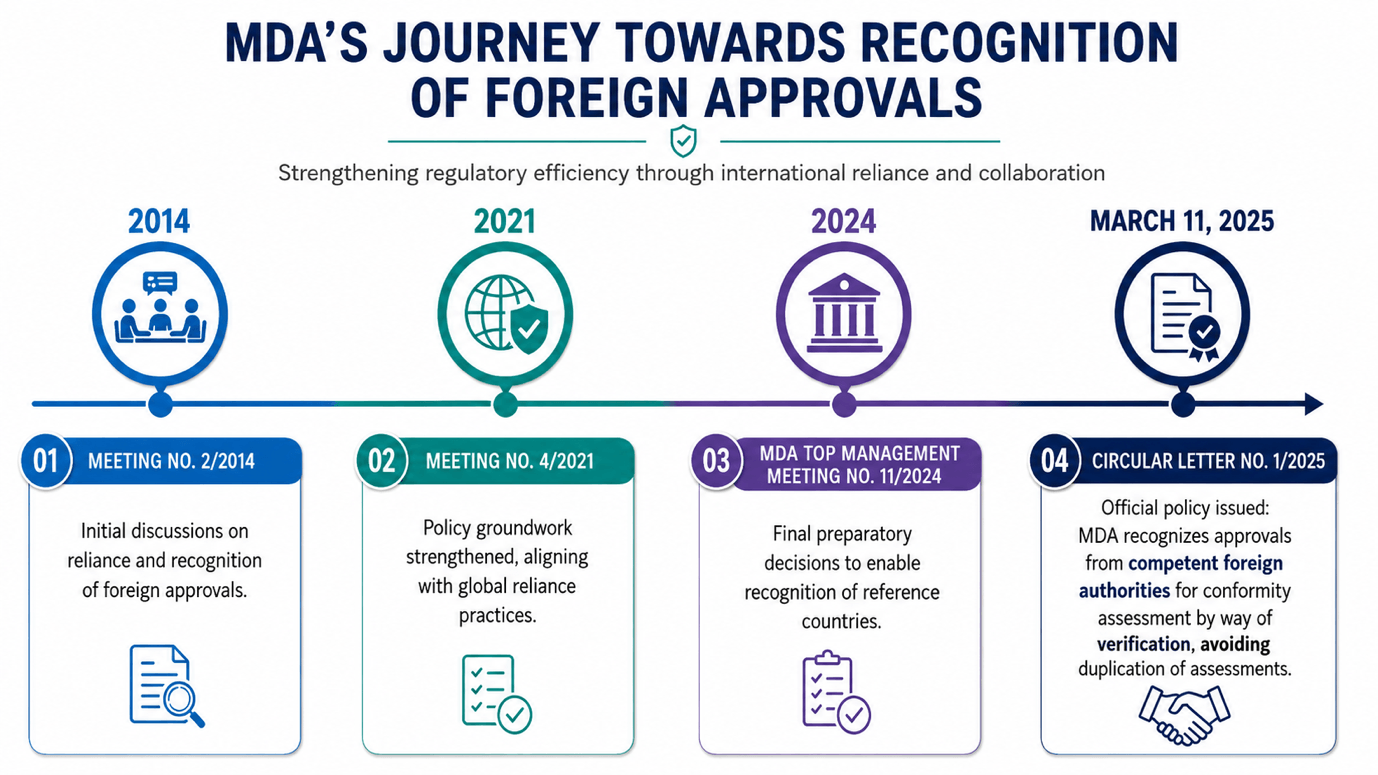
According to the MDA/GD/0068 Conformity Assessment Body (CAB) Guide for Conducting Conformity Assessment by Way of Verification, 2nd Edition (September 2025), medical devices that have obtained pre‑market clearance from any of the recognized regulatory authorities or notified bodies—namely the European Union Notified Bodies (EU NB), Japan Ministry of Health, Labour and Welfare (MHLW), Australia Therapeutic Goods Administration (TGA), Health Canada (HC), U.S. Food and Drug Administration (US FDA), Medicines and Healthcare products Regulatory Agency (MHRA), Health Sciences Authority (HSA), and the Thailand Food and Drug Administration (FDA)—are eligible to be registered in Malaysia through the verification pathway.
The verification pathway serves as an abbreviated conformity assessment route designed to streamline the registration process. It significantly reduces assessment timelines and lowers the cost of registering medical devices in Malaysia, thereby facilitating faster market entry for medical innovations. This approach ultimately enhances access to advanced technologies, strengthens the healthcare system, and delivers tangible benefits to patients across Malaysia.
MDA first permitted the appointment of multiple Authorized Representatives (ARs) for different products in the Malaysian market on 22 May 2014, through Circular Letter No. 1/2014. That policy required each individual medical device to be represented by a single AR, while allowing foreign manufacturers with multiple products to appoint different ARs, provided each product was tied to only one representative.
However, this policy was revoked effective 17 June 2021. Under the revised framework, foreign manufacturers may appoint multiple Authorized Representatives to register the same product with the MDA, subject to compliance with Sections 5 and 15 of the Medical Device Act 2012 (Act 737). This change enhances flexibility in representation, ensures continuity of regulatory responsibility, and facilitates broader market access strategies.
Since the revised framework permits multiple registrations of the same product, the question arises whether an establishment may leverage a medical device registration that has already been completed via full conformity assessment by another establishment to register through the verification pathway. At present, there is no policy allowing such reliance. But why is this not permitted? After all, the same medical device has already been assessed and approved by a recognized CAB and subsequently registered with the MDA.
In our view, this issue involves two key considerations—commercial and regulatory compliance feasibility. We believe that the MDA has duly taken into account the substantial investment made by an establishment in undertaking the timeconsuming and costly full conformity assessment required for initial registration. It would be inequitable if other establishments were permitted to leverage that registration to benefit from the verification pathway, which entails a shorter timeline and lower cost. Furthermore, it is highly improbable that the establishment which completed the full conformity assessment would willingly share its MDA medical device registration certificate for subsequent verification-based registrations with other establishments that may ultimately become direct competitors in the Malaysian market.
Do you hold a different perspective?
We welcome your thoughts—please contact Global Rep for an open exchange. We are eager to hear your input and work together to strengthen and grow the medical device industry in Malaysia.
Global Rep is your trusted partner in medical device regulatory affairs. We stay ahead of regulatory updates, carefully analyse their impact, and seamlessly integrate them into our services. Our expertise covers local authorized representation for medical device, medical device registration, registration maintenance, post‑market surveillance, and comprehensive regulatory affairs support.
Our commitment is simple: to deliver hassle‑free regulatory solutions that save you time, reduce complexity, and ensure full compliance. With Global Rep by your side, you can focus on what matters most—bringing safe, innovative medical devices to market and advancing healthcare in Malaysia.